
Most people live their entire lives not understanding what’s happening inside their own bodies.
They experience the anxiety, the anger, the shame, the panic, the numbness, the exhaustion, and they assume those feelings are evidence of who they are instead of evidence of what happened to them.
That’s the tragedy of trauma.
Not just the trauma itself. It’s the years spent believing the trauma means something is fundamentally wrong with you.
I recently read a line that captures this perfectly:
“Fear and hatred. Fear and hatred. Fear of everyone else. Hatred of himself.”
That may be one of the most accurate descriptions of trauma I’ve ever seen. And it’s something I hear almost every day.
The tragedy isn’t just the trauma itself. The tragedy is that people spend years believing the effects of trauma are evidence that something is fundamentally wrong with them. That’s the real heartbreaking part.
I’m going to oversimplify here because I think it’s the easiest place to begin a much bigger conversation.
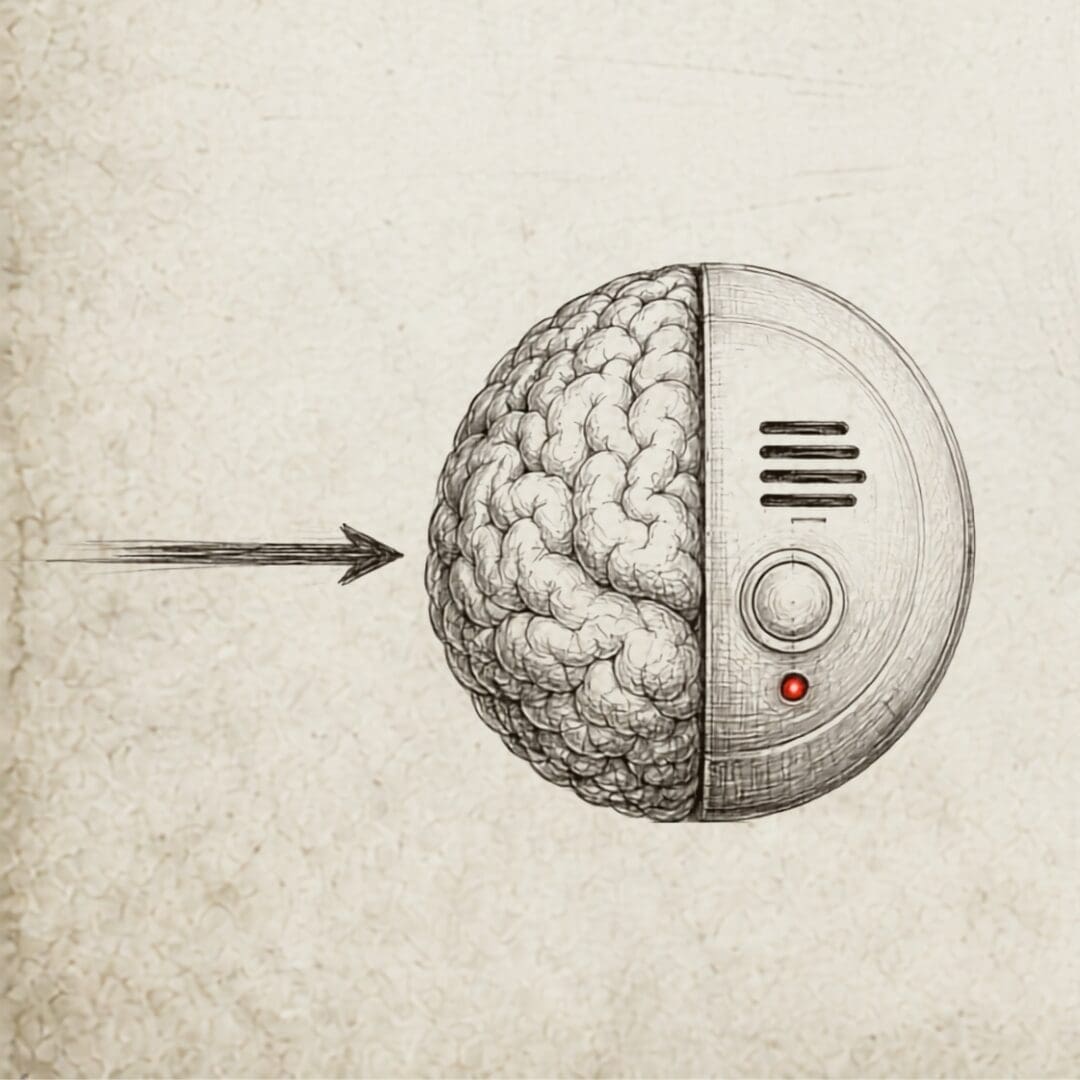
When children grow up in environments that are unpredictable, chaotic, or dangerous, their brains adapt. The amygdala, often called the brain’s smoke detector, becomes hypervigilant. Its job is simple. Detect danger and keep you alive.
I remember one apartment Rochelle and I lived in for three years. Every time we cooked, the smoke detector went off. Nothing was actually on fire, but the alarm was deafening. Living with a traumatized nervous system can feel a lot like that. The alarm is going off, but we don’t know why.
Your brain takes in roughly 11 million bits of information every second through your senses. Your conscious mind is aware of only a tiny fraction of that. The amygdala doesn’t wait for your conscious awareness. It’s constantly scanning everything outside of it, comparing what it senses to old memories of danger.
A facial expression.
A tone of voice.
A person who resembles someone else.
A room that somehow feels familiar.
Before you consciously know what’s happening, your brain has already pulled the fire alarm. Your body floods with stress hormones. Your heart races. Your muscles tighten.
Fight.
Flight.
Freeze.
Then your conscious mind finally catches up and asks,
“WTF is happening here?”
I do my best to try to explain what is happening to them.
“What you’re experiencing isn’t your fault. It’s the byproduct of an overreactive nervous system that is largely inaccurate in its threat detection, leaving you in the wake of uninvited stress hormones.” And yet it feels my efforts always fall a little short.
When you don’t understand what’s happening inside your own body, it’s easy to assume you’re the problem. Then the shame and self hatred cycle begins to loop.
People start blaming themselves for being too emotional.
Too anxious.
Too sensitive.
Too reactive.
Too much.
They don’t realize that, for years, their nervous system has been trying to protect them the best way it knows how. But here’s the part that breaks me open every time I have one of these conversations. People actually believe they somehow deserved what happened to them.
“It must have been something I did.”
“It must have been something I said.”
“There is something about me that caused this.”
I’m sitting in shock and say some form of, “You were a fucking child. On what Earth did you deserve that?”
But they always respond the same way.
“I don’t know. I must have done something.”
It’s baffling, mind boggling, and heartbreaking. But that’s the pattern I’ve seen more times than I can count.
Now, none of this means we aren’t responsible for our behavior. We must always be seeking explanations, not excuses. But it does mean we should stop confusing adaptations with identity.
The child who learned to survive is not the adult who deserves to carry the blame.
If we’re ever going to heal as individuals or as a society, we have to understand this.
Everyone is fighting battles we know nothing about.
And many people are fighting battles they don’t even understand themselves.
Sometimes the greatest act of compassion isn’t telling someone to “calm down.”
It’s recognizing they may have been hearing a smoke alarm that nobody else can hear.
And maybe, for the first time, helping them realize they were never the fire.
live freed,
Jordan
Comments +